
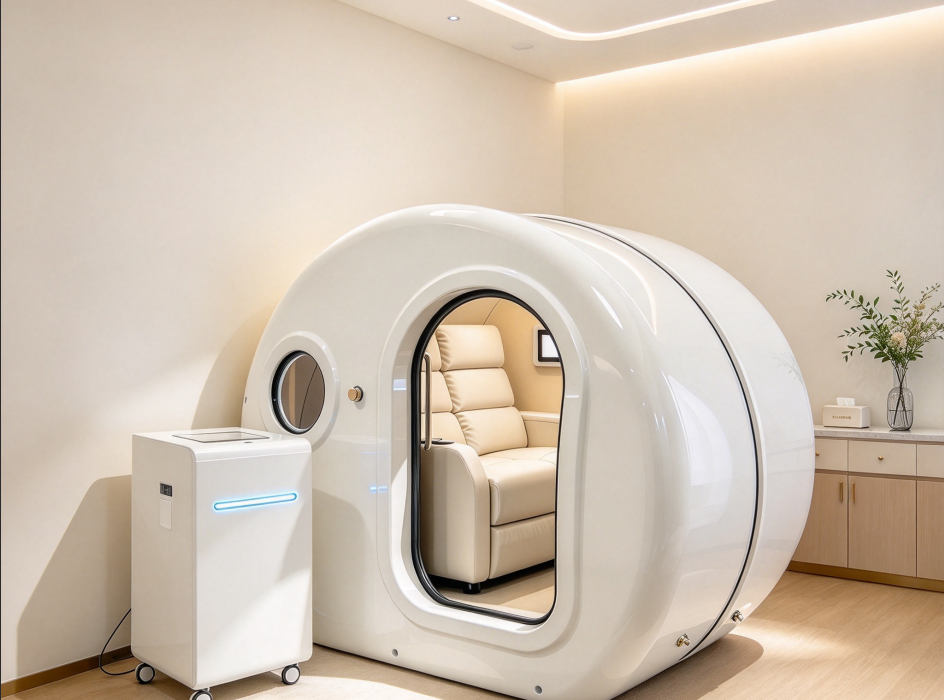
Hyperbaric chamber cost for clinics is rarely a single number. Two quotes can look identical on paper and still differ by thousands of dollars once pressure grade, chamber type, configuration, certification and installation are included. For a clinic or spa, the better question is not “What is the cheapest chamber?” but “What is the total cost of a system that fits my room, client flow and target market?” This guide explains the main cost drivers, what a quote should include, and how to compare offers on total cost rather than sticker price.
What Drives Hyperbaric Chamber Cost for Clinics?
Six factors explain most of the difference between quotes.
Pressure grade. A 2.0 ATA system needs a stronger vessel, seals, controls and safety systems than a 1.3 ATA unit. The engineering difference is real, and it shows up in the price.
Chamber type and capacity. A monoplace chamber serves one client per session. A multiplace chamber serves two to four clients at once, but requires a larger vessel, more room and more installation work. A vertical capsule serves one client in a smaller footprint.
Configuration. Oxygen concentrator, air conditioning, interior finish, control screen, voltage and plug type, software language and packaging all affect the final price. A low quote may simply exclude items you will need later.
Certification and market requirements. CE, UKCA, RoHS and other market-specific requirements add testing and documentation work. Confirm which certificates apply to the exact model and destination market.
Freight, duties and installation. International shipping, import duties, room preparation and on-site installation are often quoted separately. These items can change the total more than the chamber itself.
After-sales support. Warranty length, spare-parts availability and response time matter. A one-year warranty and 48-hour response commitment are worth more than a small discount if the chamber is central to your business.
1.3, 1.5 and 2.0 ATA: How Pressure Affects Price
OXYHB builds three pressure grades, each with an adjustable operating range. A 1.3 ATA chamber runs from 1.0 to 1.3 ATA. A 1.5 ATA chamber runs from 1.1 to 1.5 ATA. A 2.0 ATA chamber is adjustable up to 2.0 ATA.
The 1.3 ATA grade is the entry point. It uses a lighter design and is usually the lowest-cost option. It suits wellness lounges, small clinics and home users who want a compact system.
The 1.5 ATA grade is the most flexible choice for clinics and spas. Because it covers 1.1 to 1.5 ATA, one chamber can serve different client profiles and session protocols. It costs more than 1.3 ATA, but it reduces the risk of buying a chamber that is too limited for your service menu.
The 2.0 ATA grade carries the highest engineering and certification burden. It is designed for professional and clinical-grade settings where the higher pressure range is part of the business plan. It is not automatically the right choice for every spa; match the grade to your services, staff training and local regulations. You can browse the 1.3 ATA, 1.5 ATA e 2.0 ATA chamber ranges to compare configurations.
Monoplace, Multiplace and Vertical Capsule: Cost per Client
The cheapest chamber is not always the lowest cost per client. Utilization changes the math.
| Tipo de câmara | Clients per session | Upfront cost | Cost per client at high use | Best for |
|---|---|---|---|---|
| Monoplace | 1 | Lowest | Higher unless fully booked | Clinics and spas with limited space |
| Multiplace | 2–4 | Highest | Lowest when sessions are full | High-traffic wellness, sports and recovery centers |
| Vertical capsule | 1 | Low to medium | Moderada | Small rooms and single-client sessions |
A monoplace chamber is easier to install and finance, and it gives clients privacy. If you expect one or two clients at a time, it is usually the practical choice. A multiplace chamber costs more upfront, but one operator can serve several clients in the same 45–60 minute window. At high utilization, the cost per client falls quickly. A vertical capsule is a compact single-person option for rooms where floor space is tight. For a deeper comparison, read our monoplace vs multiplace vs vertical chamber guide.
What a Clinic Should Budget Beyond the Chamber
The equipment price is only one line in the budget. Ask for a written scope that covers:
| Budget line | What to confirm |
|---|---|
| Equipamento | Chamber, oxygen concentrator, air conditioning, controls, standard accessories |
| Freight and duties | Incoterm, packing, insurance, import duties and customs clearance |
| Room preparation | Floor protection, door width, ceiling height, ventilation and power |
| Instalação | Who installs, how long it takes, and whether a site visit is included |
| Training | Operator training, manuals and emergency procedures |
| Consumables | Filters, oxygen consumables and replacement intervals |
| Maintenance | Warranty, spare parts, response time and annual service cost |
| Staffing and marketing | Operator time, booking system, pricing and launch costs |
For a commercial project, OXYHB can review room layout, power configuration and installation planning before production. Standard quotes can include the oxygen concentrator, air conditioning and operator training, with FOB, CIF or DDP terms available. Lead time is typically 30–45 days, with a one-year warranty and 48-hour after-sales response.
How to Compare Hyperbaric Chamber Quotes
Do not compare only the bottom-line number. Put every quote into the same scope and check:
- Pressure range and adjustability
- Clients per session and recommended daily throughput
- Included equipment and optional items
- Certificates and the exact markets they cover
- Voltage, plug type and power requirements
- Freight, duties, installation and training
- Warranty, spare parts and response time
- Lead time and payment terms
A quote that excludes installation, training or certification may look cheaper today and cost more after delivery. Ask each supplier to confirm the same eight points in writing.
A Simple Payback Formula for Clinic Owners
Use your own numbers rather than a generic industry average:
Monthly net contribution = (sessions per month × price per session) − monthly operating cost.
Payback months = total investment ÷ monthly net contribution.
For a hypothetical example, if a clinic runs 120 sessions per month at $150 each, with $4,000 in monthly operating costs, the monthly net contribution is $14,000. A $70,000 total investment would pay back in about five months. This is an illustration only; replace the inputs with your local pricing, rent, staffing and utilization.
The lesson is that utilization and session price matter as much as the purchase price. A chamber that is fully booked can justify a higher upfront cost. A cheaper chamber that sits idle does not.
Why the Cheapest Quote Is Not Always the Lowest Cost
Low-cost offers often cut scope in ways that are hard to see: a shorter warranty, fewer spare parts, no operator training, unclear certification, or an installation plan that assumes a perfect room. In a clinic, downtime affects revenue and client trust. Compare total cost over three to five years, not just the invoice at delivery.
Get a Clinic-Specific Quote
Tell us your room size, expected sessions per day, target market and preferred pressure grade. OXYHB will recommend a chamber type and configuration, then provide a written quote with the included scope. Request a clinic quote →
Perguntas frequentes
How much does a hyperbaric chamber cost for a clinic?
There is no single price. It depends on pressure grade, chamber type, capacity, configuration, certification, freight and installation. A written quote with a clear scope is the only reliable comparison.
Is a 2.0 ATA chamber more expensive than a 1.5 ATA chamber?
Generally yes. Higher pressure requires stronger engineering, seals, controls and safety systems. The difference varies by model and configuration.
What is included in an OXYHB clinic quote?
Standard scope can include the chamber, oxygen concentrator, air conditioning and operator training. Freight, duties, installation and optional items should be confirmed in the quote.