
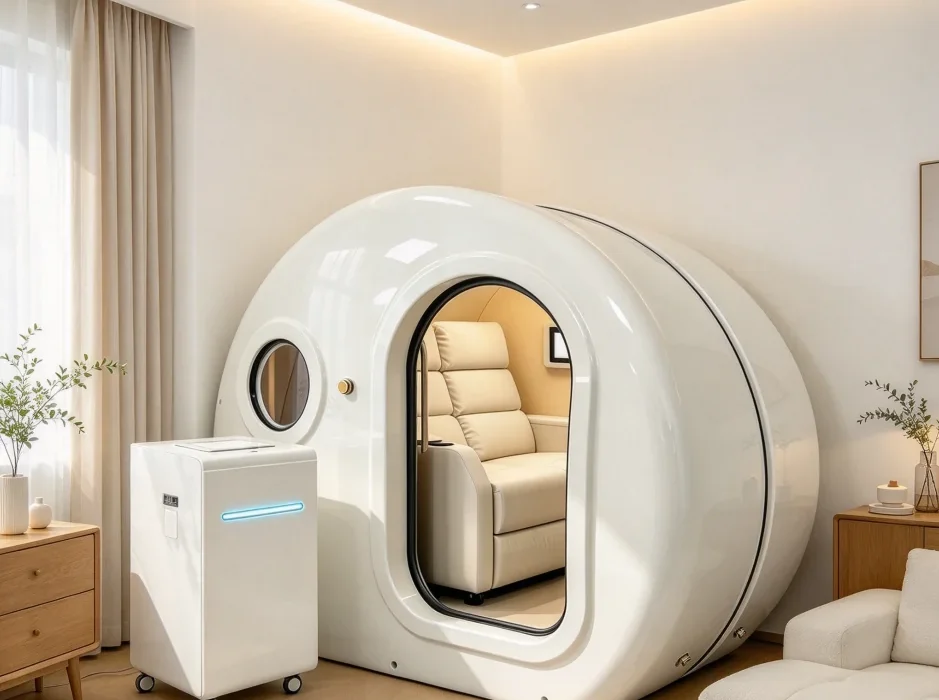
A well-planned home hyperbaric chamber installation starts before you place the order. Room access, electrical capacity, ventilation, floor space and local requirements can change both the model you choose and the final project cost.
This practical guide walks home buyers through the pre-purchase checks, chamber types, installation sequence and questions to ask a supplier. It focuses on planning rather than medical claims. Before buying or using any hyperbaric system, confirm the product’s intended use, operating instructions and applicable local regulations with the manufacturer and a qualified professional.
Home Hyperbaric Chamber Installation: Room and Delivery Route
Measure the installation space before comparing prices. The chamber must fit not only in its final position, but also through every door, lift, corridor and stairway on the delivery route. Ask the supplier for the exact packaged dimensions and weight for the model you are considering.
Check these details:
- Door width, door height, turning space and whether the door can be removed if necessary.
- Ceiling height, floor area and clearance needed for entry, controls and maintenance.
- Lift capacity and internal dimensions if the chamber must travel above the ground floor.
- Floor loading and protection requirements, particularly in apartments or upper-floor rooms.
- Space for the oxygen concentrator, air-conditioning unit, controls and any supporting equipment.
- A clear route for packaging removal after installation.
A useful test is to create a full-size floor template from the chamber’s model drawing. Leave it in the intended room for a few days. This makes walkways, doors and furniture conflicts easier to see.
Confirm Electrical and Ventilation Requirements
Never assume a standard household socket will be sufficient. Power requirements vary by chamber size, pressure grade, air-conditioning configuration and destination market. Ask for the final model’s voltage, current, phase, plug type and recommended circuit protection in writing.
Before installation, have a licensed electrician review the circuit and earthing. Use a dedicated circuit if the manufacturer recommends one, keep cables away from walkways, and confirm that the room has suitable ventilation and temperature control.
The room should remain clean, dry and free from flammable materials. Oxygen equipment must be installed and used according to the supplier’s manual and local requirements. If anything in the electrical or ventilation plan is unclear, resolve it before delivery rather than after the chamber arrives.
For a broader model-selection overview, read our complete home hyperbaric chamber buying guide.
Choose the Pressure Grade for Your Intended Use
OXYHB currently offers three adjustable pressure grades. A 1.3 ATA chamber can operate from 1.0 to 1.3 ATA. A 1.5 ATA chamber can be adjusted from 1.1 to 1.5 ATA. A 2.0 ATA chamber is adjustable up to a maximum of 2.0 ATA.
Do not select a higher pressure grade automatically because it sounds more advanced. Match the chamber to the intended operating range, required space, supporting equipment and the rules that apply where you live. Ask the supplier to explain which model fits your plan and what operating training is provided.
Typical OXYHB in-chamber sessions last 45–60 minutes. Allow additional time for setup and safe handover between users. Your actual schedule, operating procedures and suitability for use should follow the manufacturer’s instructions and any applicable local clinical guidance.
Monoplace or Vertical Capsule for Home Use
Most household buyers should compare single-user chamber formats. A capsule or vertical chamber can suit a compact room, while a monoplace hard-shell chamber offers a different layout and access experience.
| Home chamber type | Capaciteit | Pressure options | Best planning situation |
|---|---|---|---|
| Vertical capsule | One person | Available in 1.3, 1.5 or 2.0 ATA configurations | Compact floor plan and single-user sessions |
| Monoplace hard chamber | One person | Models from 1.3 to 2.0 ATA | Buyers who want a single-user hard-shell format with more model choices |
| Multiplace chamber | Up to four people on selected commercial models | Depends on model | Usually a facility rather than a typical home |
For a detailed layout comparison, see our guide to monoplace, multiplace and vertical chambers. You can also compare the 1.3 ATA, 1.5 ATA en 2.0 ATA product ranges.
Budget Beyond the Chamber Price
The listed equipment price is not the complete delivered cost. At the time of writing, OXYHB’s public shop showed capsule and vertical chamber configurations starting around USD 12,800–14,900, with larger 1.5 ATA and 2.0 ATA monoplace or clamshell systems listed higher. These figures can change and may exclude tax, freight, import duties, electrical work and room preparation, so request a current written quote.
| Budget item | What to confirm |
|---|---|
| Chamber package | Pressure grade, oxygen concentrator, air conditioning, controls and standard accessories |
| Freight and duties | Incoterm, packing, insurance, customs clearance and delivery to the exact address |
| Delivery path | Lift reservation, stairs, door removal, lifting equipment and unpacking |
| Electrical work | Circuit, socket, earthing, protective devices and inspection by a licensed electrician |
| Room preparation | Floor protection, ventilation, temperature control, storage and access |
| Commissioning | Installation, operation training, manuals and handover testing |
| Ongoing care | Filters, consumables, spare parts, warranty terms and response time |
Ask for one quote with a clearly defined scope. If an item is excluded, add a realistic local allowance so two suppliers are compared on the same basis.
Pre-Delivery Checklist
- Approve the chamber’s exact dimensions, weight and route into the room.
- Confirm that the chosen pressure grade is supported by the final model specification.
- Complete electrical and ventilation checks with qualified local professionals.
- Confirm who is responsible for delivery, lifting, assembly and commissioning.
- Agree on the required power supply, plug type and operating environment.
- Schedule operator training and save electronic and printed manuals.
- Record the serial number, warranty start date and after-sales contact.
- Keep packaging materials until testing is complete, if space allows.
What Happens on Installation Day?
A well-planned installation usually follows a clear sequence: protect the route, position the chamber, connect power and supporting equipment, complete leak and function checks, run a supervised trial, then provide training. Do not operate the chamber until the supplier has completed commissioning and confirmed that all systems work as intended.
For the first month, keep a simple maintenance log. Record filter checks, cleaning, fault messages and service requests. This makes warranty conversations easier and helps you spot recurring issues early.
Questions to Ask Before You Buy
- What are the exact installed and packaged dimensions and weights?
- What pressure range can this model be adjusted to?
- What electrical supply and circuit protection are required?
- Which parts and equipment are included, and which are optional?
- Who handles freight, customs, lifting and final installation?
- What training and documentation are included?
- What are the warranty, spare-parts and response-time commitments?
- Which certificates apply to this exact model and destination market?
- What filters and consumables require routine replacement?
- Can the supplier provide a written pre-delivery checklist for your address?
Plan the Purchase Around the Room, Not the Other Way Around
A successful home hyperbaric chamber installation is planned before the equipment is shipped. Start with the room and access route, confirm the electrical and ventilation requirements, then compare models within the space and budget you can actually support.
If you are comparing a 1.5 ATA and 2.0 ATA system, our pressure-grade comparison explains the practical differences. To match a chamber to your room and location, send OXYHB your room dimensions, delivery floor and preferred pressure range and request a written home-use quote.
Important: Hyperbaric equipment should not be used to diagnose, treat or prevent a medical condition without appropriate professional oversight. Review the FDA’s consumer guidance on hyperbaric oxygen therapy, follow the manufacturer’s operating instructions, keep oxygen equipment away from ignition sources and confirm all electrical, fire-safety and local regulatory requirements before installation and use.
Veelgestelde vragen
How much space does a home hyperbaric chamber need?
Space depends on the chamber type and its supporting equipment. Compare the exact model dimensions with the room size, door openings, lift and required maintenance clearance. A full-size floor template is a practical way to test the layout.
Can a home hyperbaric chamber use a normal wall socket?
Not necessarily. Power requirements vary by model and configuration. Use the voltage, current, phase and circuit details from the final specification, then have a licensed electrician confirm the installation.
Does a 2.0 ATA chamber always take up more space?
Not always. The footprint depends on the chamber design rather than pressure alone. Some compact capsule models are rated up to 2.0 ATA. Compare the installed dimensions, weight and supporting equipment for the specific model.
What should a home hyperbaric chamber installation quote include?
Look for equipment scope, packing, freight, insurance, customs, delivery to the room, installation, training, warranty and after-sales support. Ask each supplier to state exclusions in writing so quotes can be compared fairly.